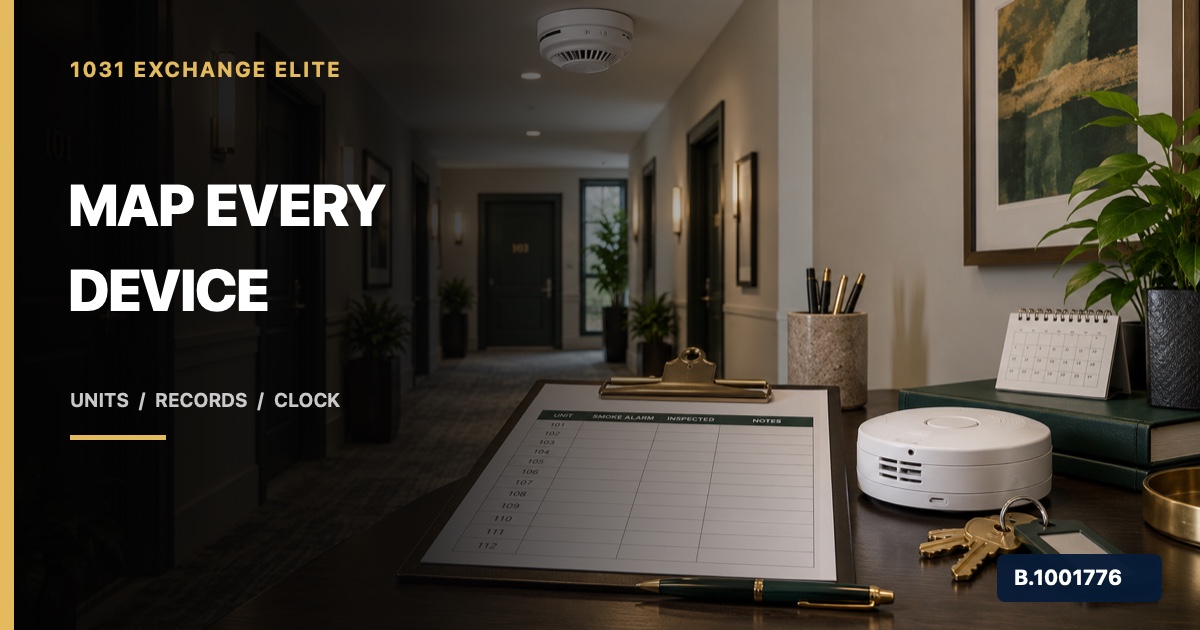
A smoke alarm rental property checklist belongs in physical, compliance, lease, maintenance, access, and capital diligence. It does not establish Section 1031 eligibility or add time to the federal exchange schedule. Build a unit-by-unit device register, reconcile it to the applicable authority and qualified professionals, then price testing, replacement, electrical work, tenant coordination, documentation, and ongoing ownership while the CPA, attorney, and qualified intermediary manage the tax structure.
Reconcile every unit and common area
List each unit, sleeping room, separate sleeping area, level, common corridor, shared system, alarm location, model, manufacture date, power source, label, interconnection, last documented test, and unresolved access item. A sample unit or seller summary is not a complete asset register.
Review responsibility across the operating cycle
Trace who inspects at acquisition, tests before move-in, responds to a failure, enters an occupied unit, documents replacement, maintains any central system, and confirms closeout. Compare leases, policies, work orders, vendor agreements, tenant notices, and actual practice without assuming they match.
Price more than the plastic device
Model device replacement, batteries where applicable, qualified electrical work, panel or circuit review, access coordination, after-hours response, staff training, record cleanup, and lost time. Ask the responsible authority and qualified professionals what the exact property requires instead of importing a rule from another jurisdiction or asset type.
Keep the exchange file in its own lane
IRS guidance keeps the federal questions focused on qualifying real property, taxpayer and title, written identification, receipt, basis, liabilities, related parties, and reporting. Alarm testing, corrective work, tenant entry, lender conditions, insurance review, or local approvals do not create extra days under the usual 45-day identification and 180-day receipt limits.
Example: the seller provides one annual invoice
The buyer matches the invoice to the building and unit register, identifies excluded spaces and inaccessible units, samples supporting work orders, obtains the relevant authority and professional guidance, prices unresolved replacements, assigns turnover controls, and updates the acquisition calendar. The invoice supports one part of diligence. It does not answer every operating or tax question.
FAQ
Is one smoke-alarm service invoice enough for rental-property diligence?
No. Reconcile the invoice to every unit, common area, device, date, access result, correction, and closeout record. Identify what was not inspected or documented.
Who decides the exact smoke-alarm requirements for the property?
The applicable statutes, adopted codes, authority having jurisdiction, manufacturer instructions, and qualified fire or electrical professionals define the property-specific answer. Do not borrow a checklist from another state.
Can alarm corrective work extend a 1031 deadline?
Do not assume so. Coordinate property work with the acquisition calendar while the qualified intermediary, CPA, and attorney manage the federal identification, receipt, taxpayer, and reporting requirements.
Primary sources and limits
- U.S. Fire Administration, Smoke Alarms
- Nevada Legislature, NAC 477.350
- Nevada Legislature, NRS Chapter 477
- IRS, Instructions for Form 8824
- IRS, Publication 544
General education only. A listing, seller statement, visible device, photograph, label, test-button result, inspection note, maintenance record, service invoice, permit entry, or exchange structure does not by itself establish complete coverage, correct placement, smoke sensing, wiring integrity, interconnection, audibility, accessibility, code compliance, insurability, lender acceptance, or future performance. Confirm the exact property type, jurisdiction, adopted code, alarm inventory, manufacturer instructions, dates, power sources, listing labels, test results, electrical system, access, corrections, and documentation with the seller, owner, tenant, inspector, qualified electrician, manufacturer, fire or building authority, lender, insurer, attorney, CPA, and qualified intermediary as appropriate. No individualized legal, tax, electrical, fire-code, lending, insurance, privacy, compliance, securities, or investment advice is provided. A CPA, attorney, and qualified intermediary must evaluate the exchange structure, taxpayer, title, deadlines, identification, receipt, basis, liabilities, boot, and reporting.
Related: keeping property protection and exchange work separate, specialist property diligence under a fixed clock, how a 1031 exchange works.