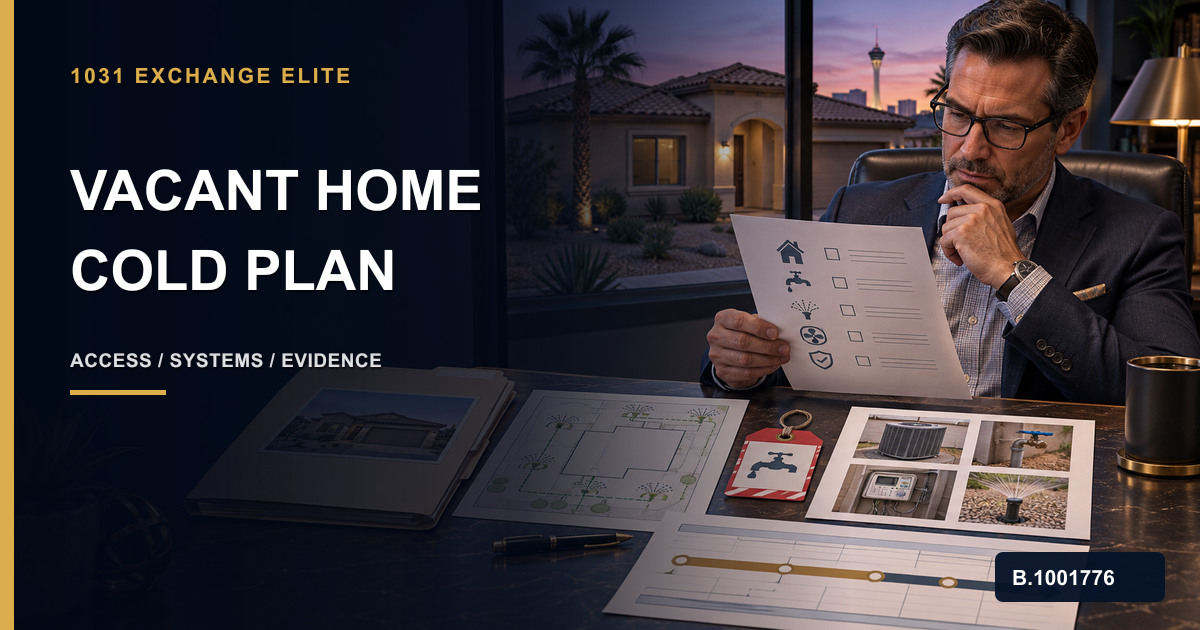
To winterize a vacant rental property, assign control before the forecast changes: who monitors conditions, maintains approved heat and utilities, protects exposed water and pool equipment, accesses the asset, shuts off water during a leak, documents inspections, and contacts the manager, insurer, utility, or contractor. In the Las Vegas Valley, Clark County warns that temperatures at or below 32 degrees can freeze pipes. Property operations still do not extend the fixed federal identification or receipt periods for a deferred 1031 exchange.
Build an asset-specific exposure register
List every building, unit, mechanical room, garage, exterior wall, hose connection, backflow device, irrigation valve, pool or spa line, fire-protection component, outdoor kitchen, and vacant space. Record condition, insulation, shutoff, service provider, lease or management responsibility, photo date, and open work order. A portfolio-wide checklist is not proof that one asset is protected.
Assign authority for utilities, heat, and access
Name the person authorized to monitor forecasts, enter each unit, maintain the approved temperature, respond to alarms, coordinate tenants or vendors, and stop water when safe. Reconcile the lease, management agreement, utility status, lender requirements, insurance terms, security system, keys, and emergency contacts. Avoid unapproved utility shutoffs or instructions that conflict with occupied-unit rights or building systems.
Separate Valley guidance from generic routines
LVVWD recommends draining hoses, protecting irrigation backflow equipment and exposed pipe, and locating water and irrigation shutoffs. It also advises against leaving pipes dripping as a generic Valley practice. Clark County and LVVWD provide pool-circulation guidance for freezing conditions. Apply the correct provider, manufacturer, manager, and qualified-contractor instructions to the asset.
Price response and downtime scenarios
Model the operational consequences of a frozen or burst line: emergency access, water removal, drying, plumbing, pool or irrigation repair, tenant accommodation, lost rent, deductibles, exclusions, inspections, permits, and restoration. Verify coverage with the insurer rather than assuming a policy responds the same way during vacancy, renovation, or turnover.
Protect the exchange calendar independently
IRS guidance generally requires written identification within 45 days and receipt within 180 days or the tax-return due date including extensions, whichever is earlier. Freeze preparation, repair work, insurance review, vacancy, lender changes, and contractor delays do not automatically extend those dates. Keep the QI, CPA, attorney, lender, closer, manager, and property team aligned on separate owners and deadlines.
FAQ
Who should winterize a vacant rental property?
The responsible owner, manager, tenant, vendor, or contractor depends on the governing agreements and local requirements. Assign the role in writing and verify completion with current evidence.
Should a vacant Las Vegas rental have faucets left dripping?
Do not assume so. LVVWD says typical Valley conditions generally do not warrant leaving pipes dripping. Follow current local-provider, property-system, insurer, manager, and qualified-professional guidance.
Can a frozen pipe extend a 1031 exchange deadline?
There is no automatic extension for a property repair. The taxpayer should ask the qualified intermediary, CPA, and attorney about the exact facts while protecting the statutory calendar.
Primary sources and limits
- Clark County Fire Department, Cold Weather Winter Safety
- Las Vegas Valley Water District, Watering Tips: Pipes and Hoses
- IRS, Publication 544, Sales and Other Dispositions of Assets
- IRS, Instructions for Form 8824
General education only. An article, forecast, checklist, inspection, photo, service note, referral message, listing record, utility status, property-management record, or qualified-intermediary instruction does not by itself establish property condition, freeze protection, repair completion, insurance coverage, access authority, lease responsibility, code compliance, exchange qualification, license status, or professional acceptance. Verify the exact property, forecast, pipe and irrigation exposure, pool and heating equipment, water and utility controls, vacancy and occupancy status, lease and management duties, access, insurer and lender requirements, manufacturer instructions, qualified contractors, responsible people, exchange structure, taxpayer, use, deadlines, receiving license, secure communication channel, and completion evidence with the applicable utility or water provider, licensed real-estate professionals, property manager, insurer, lender, plumber, pool or irrigation professional, qualified intermediary, CPA, attorney, tax adviser, and other qualified professionals. No individualized legal, tax, lending, insurance, securities, appraisal, inspection, engineering, plumbing, property-management, fair-housing, or investment advice is provided. A CPA, attorney, and qualified intermediary must evaluate the taxpayer, investment-use position, exchange structure, acquiring party, title, deadlines, identification, receipt, basis, liabilities, boot, reporting, and vendor documents.
Related: auditing winter irrigation operations, planning moisture and leak diligence, start a 1031 property-strategy conversation.